
How much iron per day for children? – Daily requirement & dosage by age
Iron is one of the important trace elements for growing up. As a component of the red blood pigment haemoglobin, it is involved in the formation of red blood cells, in oxygen transport and in the cognitive development of children. Because children grow continuously, build muscle tissue and increase their blood volume, the body depends on a steady intake of iron.
But how much iron per day is recommended for children at which age? How do the recommendations for toddlers, school-age children and teenagers differ? And what is the difference between the daily dietary requirement and the dosage of food supplements? This guide gives parents an overview of the current reference values and puts questions about dosage into context.
Key points at a glance
- The daily iron requirement rises with growth and, during puberty, depends on sex – according to the DGE, from 0.3 mg in infants to 16 mg in menstruating girls.
- From the 4th month, the reference value for infants is comparatively high (11 mg/day), because the innate stores are largely used up.
- Iron from animal foods (haem iron) is usually absorbed better than plant-based non-haem iron.
- The dietary reference value and the supplement dosage are two different things: for food supplements, the BfR recommends a maximum of 6 mg of iron per daily portion.
- An inadequate supply over the long term can contribute to iron deficiency. Healthy children do not need high-dose supplements without a medical reason.
All topics at a glance
- Children’s daily iron requirement by age
- Why is the reference value for infants comparatively high from the 4th month?
- Iron requirement in children vs. teenagers
- How is the iron requirement normally met through diet?
- Do vegetarian and vegan children need more iron?
- Daily iron requirement vs. supplement dosage
- Medical iron dosage on prescription
- Should children take iron as a precaution?
- Can too much iron be problematic?
- When should iron status be checked at the paediatrician’s?
- Frequently asked questions
Children’s daily iron requirement by age: DGE reference values at a glance
The German Nutrition Society (DGE) has defined reference values for daily nutrient intake.¹ These values indicate how many milligrams (mg) of iron healthy children and teenagers should take in per day through a wholesome diet in order to reliably meet their requirement:
| Age group | Boys | Girls | Notable features & stage of development |
|---|---|---|---|
| 0 to under 4 months | 0.3 mg/day | 0.3 mg/day | Estimated value; fully breastfed infants draw on their innate stores. |
| 4 to under 12 months | 11 mg/day | 11 mg/day | Increased requirement due to rapid growth and the depletion of the newborn stores. |
| 1 to under 4 years | 7 mg/day | 7 mg/day | Toddler phase; transition to the normal family diet. |
| 4 to under 7 years | 7 mg/day | 7 mg/day | Stable baseline growth in nursery and pre-school age. |
| 7 to under 10 years | 10 mg/day | 10 mg/day | Start of primary-school age; increasing physical and mental activity. |
| 10 to under 13 years | 14 mg/day | 14 mg/day* | Pre-pubertal growth spurt (*already 16 mg/day with early menarche). |
| 13 to under 15 years | 11 mg/day | 16 mg/day | Sex-specific differentiation due to the onset of menstruation. |
| 15 to under 19 years | 11 mg/day | 16 mg/day | Teenagers in the transition to adulthood. |
For comparison – the EFSA values: The European Food Safety Authority (EFSA) uses somewhat different age groups and calculation models. For example, it states 11 mg/day each for infants aged 7–11 months and for children aged 7–11 years, and 13 mg/day for menstruating girls aged 12–17 years.² Such discrepancies are normal – for Germany, the DGE reference values are the authoritative ones.
Why is the reference value for infants comparatively high from the 4th month?
At birth, babies born at term have well-filled iron stores that supply them for the first 4 to 6 months of life. After that, these reserves are largely used up. Because the baby triples its body weight in the first year of life and forms enormous amounts of new blood cells, the reference value rises to 11 mg/day from the 4th month.³
Iron requirement in children vs. teenagers: why do the values rise during puberty?
While the requirement in toddler and primary-school age is between 7 and 10 mg of iron per day, the physiological demands change significantly during puberty. From around the age of 13, sex plays a role for the first time:
-
Teenage boys (11 mg/day): During the pubertal growth spurt, boys rapidly build muscle mass and their entire blood volume expands. The daily requirement is 11 mg/day, as there are no cyclical blood losses.
-
Teenage girls (16 mg/day): With the onset of the first menstrual bleeding (menarche), the female body regularly loses blood and, with it, bound iron. To reliably compensate for these menstrual iron losses, the DGE recommends that girls from the age of 13 (and those whose periods start earlier) take in 16 mg of iron daily.
How is the iron requirement normally met through diet?
The reference values given always relate to the total iron intake through food. From an average mixed diet, the human gut absorbs only about 10 to 15 percent of the iron it contains. The source is decisive here: at around 15 to 35 percent, haem iron from animal foods has a considerably higher bioavailability than non-haem iron from plant foods, which is only absorbed at about 2 to 20 percent.

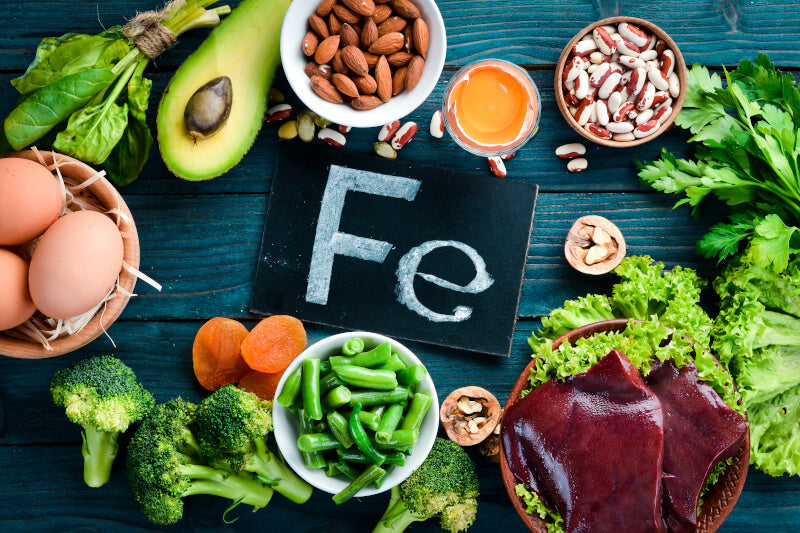
Good sources of iron for children are therefore red meat and – on the plant side – pulses.
To put this into context, a few examples of the iron content of iron-rich foods:
-
Chicken contains about 1 mg of iron per 100 g.
-
Cooked spinach provides around 2 to 3 mg per 100 g.
Which foods are best suited and what role vitamin C plays, we show in detail in the guide: Which foods are high in iron for children?
Milk, tea and coffee: the inhibitors parents should know about
It is not only the selection but also the combination of foods that influences absorption. Dairy products can reduce iron absorption when consumed directly with an iron-rich main meal – the reason is the calcium they contain. Tea and coffee (relevant in teenagers) can also inhibit absorption through their tannins. A time gap of one to two hours helps to avoid this effect.
Do vegetarian and vegan children need more iron?
Plant-based iron (non-haem iron) has a lower biological availability than iron from meat or fish. In addition, many plant foods such as grains or pulses contain natural inhibitors (phytates) that can reduce iron absorption in the gut. Professional bodies therefore assume an iron requirement roughly 1.8 times the reference intake for people on a purely plant-based diet.
1.8×
is how much higher the iron requirement is set for a purely plant-based diet, because plant-based iron is less readily available.
Parents of children on a vegetarian or vegan diet should therefore pay particular attention to a varied composition of meals. While officially the same basic DGE reference values apply, in practice the intake of plant-based iron sources often has to be planned more generously or deliberately combined with vitamin C-rich ingredients in order to optimise absorption.
Daily iron requirement vs. supplement dosage: what is the difference?
When it comes to the question of the right amount of iron, many parents confuse two terms:
-
The daily dietary requirement (reference value): The recommended total amount of iron (e.g. 7 to 16 mg) that the child should take in with all meals spread across the whole day.
-
The dosage in food supplements: Food supplements are there to complement a balanced diet – not to replace it entirely. The German Federal Institute for Risk Assessment (BfR) recommends a maximum amount of no more than 6 mg of iron per recommended daily portion for food supplements, in order to avoid an unintended oversupply in everyday life.⁴
Medical iron dosage on prescription
This must be strictly distinguished from the therapeutic dosage of medicines: if genuine anaemia is identified in a child through a blood test, the paediatrician prescribes therapeutic doses of usually 2 to 6 mg of iron per kilogram of body weight per day.⁵ This high-dose administration takes place exclusively for a limited time and under medical supervision.
Should children take iron as a precaution?
Healthy children who eat a varied diet and appear fit do not need high-dose iron supplements on suspicion.
Can too much iron be problematic?
Iron is actively stored in the human body and, with an excessive intake, cannot simply be excreted via the urine. The European Food Safety Authority (EFSA) has therefore formulated guidance values for a safe intake (Safe Levels of Intake):
-
Toddlers (1 to 3 years): Up to 10 mg of iron per day (from fortified foods and supplements) is considered safe.
-
Teenagers (15 to 17 years): Up to 35 mg of iron per day represents the safe upper limit.²
A sustained, untargeted overdose can lead to gastrointestinal complaints such as abdominal pain, nausea or constipation. Gentle supplementation with moderately dosed nutrients can be considered during certain growth phases or with fussy eaters – but high-dose medicines always belong in medical hands.
When should iron status be checked at the paediatrician’s?
Having the blood values checked is advisable if children appear strikingly listless over a longer period, are going through phases of extreme growth, if girls have very heavy periods, or if a strict plant-based diet is followed without professional nutritional guidance.
An inadequate iron supply over the long term can contribute to iron deficiency and – as factual information from nutritional science – impair the cognitive development of children. Which symptoms may occur and how the exact diagnosis works, we cover separately in the guide Iron deficiency in children.
For targeted support of daily nutrient intake in the family routine, parents often choose child-friendly dosage forms such as fruity gummies. Among other things, iron contributes to the normal formation of red blood cells; you can find the exact nutritional information and recommended intake of the specific product directly on the product page for the iron gummies.
Frequently asked questions: how much iron do children need?
Can iron supplements turn the stool dark?
Yes. Iron that is not absorbed is excreted via the gut and can temporarily colour the stool dark to blackish. This is as a rule harmless and disappears again once the supplement is stopped. If in doubt, a quick trip to the paediatrician is worthwhile.
From what age are iron gummies suitable for children?
That depends on the particular product. Which age group a supplement is intended for and what the recommended intake is are always stated on the packaging or product page. For young children, administration should be discussed with a doctor beforehand.
Is it better to give iron daily or every other day?
In adults, studies suggest that giving iron every other day may improve absorption per dose. For children there is less robust data on this – the appropriate intake rhythm should therefore always be determined by a doctor.
Professional note: This article is intended for general information and does not replace medical or nutritional advice. If you have questions about your child’s iron supply, please consult a paediatrician.
Legal context and scientifically verified effects
In accordance with the European Food Safety Authority (EFSA) and the Health Claims Regulation (EC) No 1924/2006, the following functions of iron are scientifically confirmed:
-
Iron contributes to normal cognitive development of children.
-
Iron contributes to a normal energy metabolism and to the reduction of tiredness and fatigue.
-
Iron contributes to normal formation of red blood cells and haemoglobin as well as to normal oxygen transport in the body.
-
Iron contributes to normal function of the immune system.
Sources
-
German Nutrition Society (DGE) (2024): Reference values for nutrient intake: Iron. DGE e. V., Bonn.
-
European Food Safety Authority (EFSA): Scientific Opinion on Dietary Reference Values for iron (2015), EFSA Journal, 13(10):4254; and Scientific opinion on the tolerable upper intake level for iron (2024), EFSA Journal, 22(6):8819.
-
ESPGHAN Committee on Nutrition (Domellöf, M. et al., 2014): Iron Requirements of Infants and Toddlers: A position paper by the ESPGHAN Committee on Nutrition. Journal of Pediatric Gastroenterology and Nutrition, 58(1), 119–129.
-
German Federal Institute for Risk Assessment (BfR) (2021): Proposed maximum amounts for iron in food supplements. BfR opinion.
-
American Academy of Pediatrics (AAP) (Baker, R. D. et al., 2010): Diagnosis and Prevention of Iron Deficiency and Iron-Deficiency Anemia in Infants and Young Children (0–3 Years). Pediatrics, 126(5), 1040–1050.
Leave a comment
This site is protected by hCaptcha and the hCaptcha Privacy Policy and Terms of Service apply.