
Sugar or sweetener: which is best?
Im Durchschnitt nimmt jeder Deutsche 95 Gramm Zucker am Tag zu sich.1 On average, every German consumes 95 grams of sugar per day.
Most of it is hidden in ready-made meals and processed foods. According to surveys, more and more people believe that consuming sugar harms our health.
- In this article, you will learn
- what alternatives there are to the popular sweetener
what advantages and disadvantages they have
What exactly is sugar?
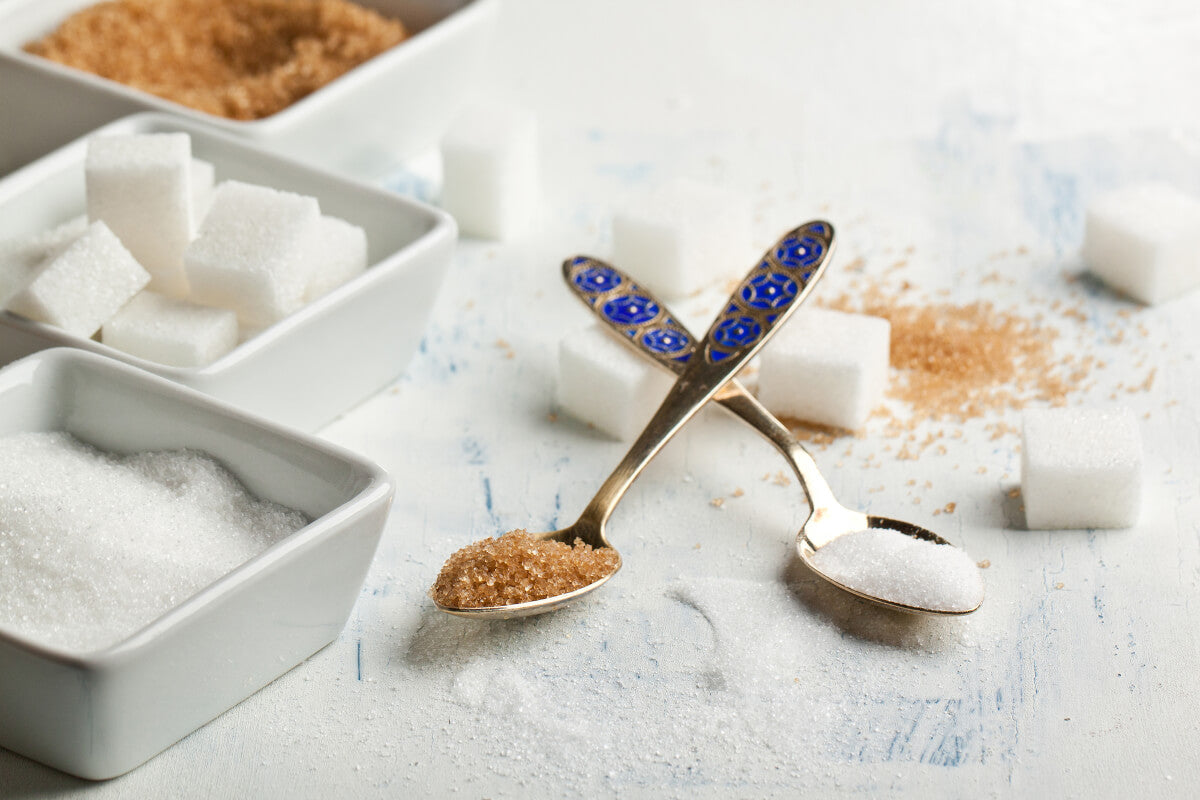
The term sugar, refined sugar, or granulated sugar refers to ordinary table sugar, which is available in every grocery store. Chemists also call it sucrose (cane sugar). This molecule is a so-called disaccharide consisting of glucose (grape sugar) and fructose (fruit sugar).
In addition to sucrose, fructose, and glucose, many other sugars occur in nature. Depending on their chemical composition, they are called monosaccharides (simple sugars), disaccharides, polysaccharides (complex sugars), sugar alcohols, and carbohydrates.
So what is the difference between sugar and carbohydrates? Strictly speaking, there is none: carbohydrates are sugars! However, food manufacturers distinguish between carbohydrates and sugar in nutrition tables.
The term sugar refers exclusively to monosaccharides and disaccharides.2 Carbohydrates also include all polysaccharides and sugar alcohols that our bodies can digest.
table sugar is considered one of the problematic products Many Many people are critical of sugar consumption. Because white granulated sugar suspected, overweight, diabetes mellitus, cancer and promote Alzheimer's disease. In an article dated April 7, 2018, entitled This is what sugar does to our bodies t-online reported on current research findings on this topic.3
Do foods containing granulated sugar actually pose health risks? Since the study results published to date are inconclusive, we do not know with absolute certainty. One effect of table sugar and other carbohydrates is undisputed: they raise blood sugar levels.
The extent of the rise in blood sugar can be described using two terms: the glycemic index (GI) and the glycemic load (GL).4
- The lower the glycemic index, the less and more slowly the blood sugar level rises.
- The glycemic load is considered an indicator of the insulin requirement triggered.
The body's own hormone insulin ensures that blood sugar can enter our cells and be processed there. Anyone who frequently consumes sugary foods and drinks repeatedly raises their blood sugar level, followed by the release of insulin.
Why is it problematic? At first, fluctuations in blood sugar cause no symptoms. Over time, blood sugar levels remain constantly elevated, and can resulting in insulin resistance develop, the precursor to diabetes mellitus type 2. As the NDR reported in an article dated May 17, 2021, the consequences include nonspecific symptoms such as fatigue, lack of energy as well as general malaise on.5
To avoid getting caught in this vicious cycle, it is important to eat food that causes blood sugar levels to only causes it to rise slowly. Be honest: How often do you have cookies, gummy bears, cake, or cola at home? The American pediatrician Prof. Lustig is convinced that sugar is addictive and should definitely be regulated by lawmakers.6
Processed foods contain a lot of sugar and little fiber. Unprocessed food contains hardly any sugar, but plenty of fiber. Little sugar means that the liver is not burdened, and a very large proportion of all that fiber benefits the bacteria in the digestive tract. That is why I always say: People, eat real food.
Prof. Dr. Robert R. Lustig, University of California, San Francisco.7
But fruit also contains sugar in the form of fructose. Is sweet fruit just as unhealthy as processed foods, then? At this point, we need to distinguish between naturally occurring varieties of fruit and highly cultivated “turbo fruits.”
The latter can indeed contain larger amounts of sugar and are therefore considered problematic foods. Unprocessed fruit from organic farming contains only small amounts of fructose, so our bodies have no difficulty processing it. In addition, healthy fruit contains plenty of fiber, vitamins, and minerals.
What alternatives to table sugar are there?
Supermarkets, organic food stores, and health food stores now offer numerous alternatives for sweetening food and drinks. Below, we present the most important products.

Brown Sugar and Whole Cane Sugar
In addition to white table sugar, stores also sell whole cane sugar and brown sugar. What is the difference? Brown sugar is nothing more than less thoroughly refined granulated sugar. Its dark color comes from the impurities it still contains.
By contrast, whole cane sugar is not refined. It is pure sugarcane juice from which the water has been removed. As a result, the product still contains all the minerals and vitamins of the sugarcane. The glycemic index is also lower than that of brown sugar and ordinary table sugar.8
Natural sweeteners
As sugar substitutes, honey, agave syrup, and maple syrup are popular with many people. What are the advantages and disadvantages of these natural products?
Honey
Who doesn't know the delicious bee honey offered in a variety of flavors? Some people spread it directly on their bread rolls or use it to sweeten foods, drinks, and smoothies. Honey consists of 80 percent polysaccharides, disaccharides, and the monosaccharides glucose and fructose.
It also contains essential vitamins, minerals, amino acids, enzymes, and organic acids. Thus, genuine honey is healthier than refined granulated sugar. However, because of its high sugar content, it is still not a true alternative for adults and children.
Unfortunately, even with expensive honey, you cannot be sure that the product is unadulterated. It is best to buy natural honey directly from a trustworthy local beekeeper.
Agave syrup
Agave syrup is a natural product obtained from Mexican agave species. This sweetener, which is especially popular in vegan cuisine, is also known as agave nectar or agave juice.
Agave syrup contains up to 90 percent fructose and therefore has greater sweetening power than table sugar. It dissolves well in water and liquid foods. Unlike other thick syrups, agave syrup has no distinctive flavor of its own.
Depending on the processing method, it may also contain secondary plant compounds, trace elements, and vitamins. Since fructose has had a bad reputation for some time, agave syrup is therefore not really suitable for health-conscious people.9
For this reason, the much cheaper agave roots are often used for industrial processing. Such products no longer bear any resemblance to genuine agave syrup.

Maple syrup
Because it contains less fructose, maple syrup is considered a healthier alternative to agave syrup and other thick syrups. Those who use this natural product as a sweetener also provide their bodies with valuable trace elements and vitamins. The sticky syrup is obtained by “milking” the sugar maple tree.
Maple syrup consists of about 60 percent sucrose. Although this natural product contains the same type of sugar as table sugar, blood sugar levels rise because of the lower glycemic load more slowly.10
What are sweeteners?
Meanwhile, the food industry adds so-called sweeteners to numerous processed foods to replace sugar. In a publication from 2007, the German Nutrition Society (DGE) stated: “Sweeteners can be useful aids in reducing energy intake as part of weight-loss programs.”11
But what exactly are sweeteners? Food chemists use this term to refer to artificially produced sugar substitutes. They have considerably greater sweetening power than conventional sugar and are therefore used in smaller quantities.
There are currently eleven approved sweeteners in the EU. The best-known representatives include aspartame, cyclamate, and sucralose. In addition, there is the food additive Stevioside (steviol glycosides), a component of the stevia plant.
Scientific studies point to risks associated with regularly consuming sweeteners
By now, there is extensive scientific research on artificially produced sweeteners. Apparently, they can when consumed over a prolonged period cause health problems. On September 18, 2014, the Süddeutsche Zeitung an article titled Sweeteners under suspicion: Can sweeteners also trigger diabetes? That is what a new study from Israel suggests.12
Under the title Sweeteners alter the blood vessels reports Die Welt On April 24, 2018: “In animal experiments, scientists obtained new evidence as to why calorie-free sweeteners do not necessarily make people slim and may even be harmful. In rats and cell experiments, they found that consuming certain sweeteners adversely alters metabolism as well as the lining of the blood vessels.”13
Many people use sweeteners instead of sugar to lose weight. In 2017, Canadian biologists from the University of Manitoba reached a shocking conclusion. They analyzed a total of 37 studies involving more than 400,000 participants.
“No connection could be demonstrated between consuming sweeteners such as stevia, aspartame, sucralose & co. and weight loss. Quite the opposite, in fact. Longer-term observations had shown that consuming sweeteners was associated with a higher risk of weight gain, the researchers wrote.”14
But stevia is supposed to be so healthy and even lower blood sugar levels in diabetics. Is that not true? This statement applies to the tasty leaves of the stevia plant and not to steviol glycosides from a chemical laboratory. Incidentally, you can easily grow stevia yourself.15,16
Sugar substitutes
In addition to sweeteners, the EU has approved another group of sweetening agents: sugar substitutes. In most cases, these are so-called sugar alcohols. Do not worry, this term does not mean that sugar substitutes contain high-proof alcohol (ethanol).

In chemistry, alcohols constitute a specific class of organic compounds, similar to amino acids or vitamins. In addition to sugar alcohols, fructose, inulin, isomaltulose, and corn syrup also fall under the collective term sugar substitutes.
Although the properties of these compounds differ considerably, they have one thing in common: Consuming foods or drinks that contain sugar substitutes instead of sugar causes blood sugar levels to rise less after consumption than when consuming foods or drinks containing sugar. That is why they are often found in foods for diabetics.17,18
In terms of taste and sweetness, sugar substitutes are similar to ordinary table sugar. They also enhance the natural flavor of fruits and other foods.
Which sugar alcohols are used in the food industry?
Among the most important sugar alcohols are Sorbitol, erythritol, maltitol, xylitol, mannitol, lactitol, and isomalt. Below, we would like to take a closer look at xylitol and maltitol. Why are these two sugar substitutes beneficial for our teeth? Consuming foods/drinks that contain xylitol and maltitol instead of sugar helps maintain tooth mineralization.
Xylitol (xylitol) has been used to sweeten foods for more than 100 years. Originally, manufacturers used birch bark as the raw material. This is where the still commonly used name birch sugar comes from. Nowadays, it is mainly obtained from corn cobs, cereal bran, straw, and sugar cane.
The flavor-neutral Birch sugar is therefore not a natural product, but an artificially manufactured industrial product. At 240 calories (kcal) per 100 grams, xylitol has around 40 percent fewer calories than table sugar. Because of its complex production process, the final product is relatively expensive. One significant Disadvantage of birch sugar compared with white sugar is that, that it possesses that it according to a British study from 2007 in amounts from 35 grams watery.19
diarrhea can cause Similar properties like xylitol the sugar alcohol maltitol. It is usually obtained from corn starch, wheat starch, and glucose syrup., According to the German Consumer Initiative, maltitol is considered harmless. Consuming larger quantities can cause diarrhea stomach aches and.20
bloating therefore, foods in which the proportion of sugar substitutes is more than 10% carry the warning “may have a laxative effect if consumed to excess” Compared with birch sugar, Maltitol has a weaker laxative effect. With a value of 35, maltitol’s glycemic index is significantly less than granulated sugar (GI 65) however than xylitol (GI 13).21,22
In a in a placebo-controlled double-blind study from 2010 entitled Short term digestive tolerance of chocolate formulated with maltitol in children (Short-term digestive tolerance of chocolate with maltitol in children) came French researchers came to the following conclusion: “Our results suggest that maltitol was well tolerated by children at an amount of 15 grams per serving”.23
Are sugar substitutes the perfect solution for young and old?
Sugar-free chewing gum helps maintain tooth mineralization. However, anyone who continues to eat a lot of sweets and replaces their daily sugar consumption one-to-one with sugar alcohols will exceed the maximum tolerance limit by far.
To avoid intestinal discomfort and diarrhea, one should consume no more than 0.5 grams of xylitol or maltitol per kilogram of body weight. For a woman weighing 60 kilograms, this corresponds to 30 grams (3 heaped teaspoons) per day. For this reason, you cannot eat Xylitol & Co. just as sweetly as you are used to with sugar.
Conclusion
According to Prof. Lustig, we should eat unaltered foods rather than industrially processed food. An apple, preferably from an organic food store, contains no long list of preservatives, colorants, and other artificially added chemicals.
Antje Gahl of the German Nutrition Society adds: “Instead of replacing sugar with sweeteners, the DGE recommends generally changing your diet to be ‘less sweet.’”13
Whether sugar or other sweeteners: the amount is what causes the problem. If you cook at home yourselves and eat chocolate occasionally, the body can easily handle it. It only becomes a health concern when a genuine craving for sweets develops.
Leave a comment
This site is protected by hCaptcha and the hCaptcha Privacy Policy and Terms of Service apply.