
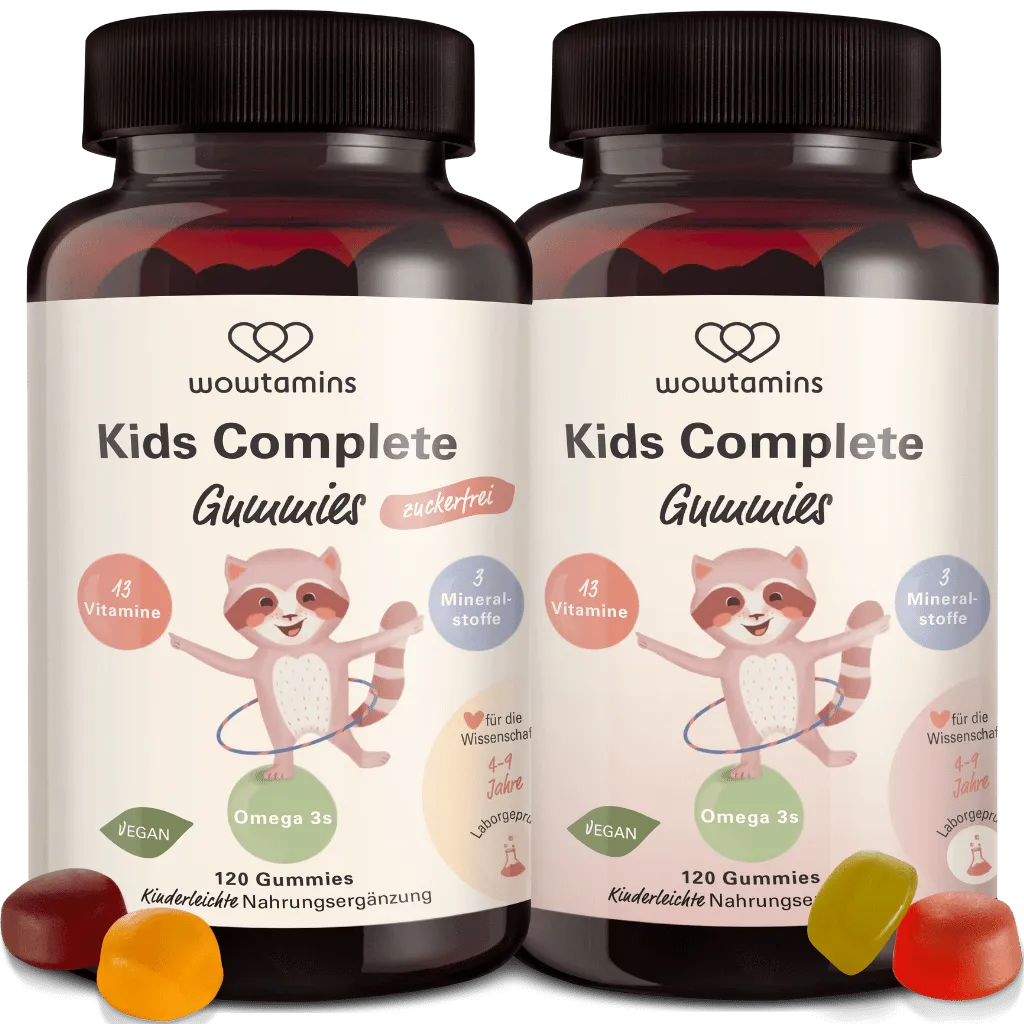


Vitamin D for kids: recognising and addressing low levels
According to current research findings, more than nine out of ten children in Germany have an insufficient vitamin D supply.1 These alarming figures are primarily attributable to our modern lifestyle and various environmental influences.2
How much vitamin D does the human body need per day?
When is a child considered to have vitamin D deficiency?
Symptoms of vitamin D deficiency in children
Correcting vitamin D deficiency in children
When is vitamin D3 supplementation worthwhile?
Conclusion: Vitamin D deficiency in children
- why vitamin D3 is so important
- how the body’s own production can best be stimulated
- what you can do in autumn and during the winter months to prevent vitamin D deficiency in children
What exactly is vitamin D?
Biochemists do not use the term vitamin D to refer to a single molecule, but to a group of specific fat-soluble substances. The most important member of the vitamin D family is considered to be cholecalciferol, which is also known as vitamin D3. Strictly speaking, vitamin D differs fundamentally from all other vitamins.
By definition, a vitamin is an essential nutrient that our bodies must obtain through food. The situation is different with vitamin D: Humans and almost all vertebrates can produce cholecalciferol themselves.
What we need for this is sufficiently intense ultraviolet radiation from the sun, which penetrates our outer layer of skin (epidermis). For this reason, the valuable biomolecule is also known as the sunshine vitamin.
Vitamin D has another special feature compared with all other vitamins: Its biologically active form, calcitriol, acts as a hormone produced by the body.
Why children need vitamin D3
In the past, scientists and doctors believed that the essential function of vitamin D was to build healthy bones. This was because the bone disease rickets, which was widespread among infants and young children at the beginning of the 20th century, was treated with vitamin D.3
Today, we know that vitamin D is also involved in and contributes to other processes
- to the normal absorption/utilization of calcium and phosphorus
- to normal blood calcium levels
- to the maintenance of normal bones
- to the maintenance of normal muscle function
- to the maintenance of normal teeth
- to the normal function of the immune system
- and plays a role in cell division
Vitamin D3 + K2 Gummies

Vitamin K2-MK7 (all-trans)
as delicious gummies
How much vitamin D do children and adults need per day?
According to the German Nutrition Society (DGE), adults and children have a minimum daily requirement of 20 micrograms (µg) of vitamin D. This corresponds to 800 International Units (IU). Specifically, the DGE provides the following reference values:
| Age | Daily vitamin D requirement |
|---|---|
| Infants (0 to 12 months) | 10 µg (400 IU)* |
| Children and adolescents (1 to 18 years) | 20 µg (800 IU) |
| Adults | 20 µg (800 IU) |
| Pregnant women | 20 µg (800 IU) |
| Breastfeeding women | 20 µg (800 IU) |
Required vitamin D intake in the absence of sunlight.6
* Estimated values
When is a child considered to have vitamin D deficiency?
Our body converts vitamin D3 in the liver into the intermediate form 25-OH vitamin D3, which is also known as 25(OH)D. This biomolecule remains stable in the blood for a relatively long time and serves as the storage form of vitamin D. For this reason, it is well suited for diagnosing vitamin D3 deficiency.
A laboratory determines the concentration of 25-OH vitamin D3 in blood serum. It is reported either in nanograms per milliliter (ng/ml) or nanomoles per liter (nmol/l). The following results are possible when measuring it:
Overview of 25(OH)D levels in blood serum7
- Severe deficiency: less than 7 ng/ml (17.5 nmol/l)
- Deficiency: below 20 ng/ml (below 50 nmol/l)
- Insufficient supply: 20 to 29 ng/ml (50 to 72.5 nmol/l)
- Normal levels: 30 to 59 ng/ml (75 to 147.5 nmol/l)
- High levels: 60 to 89 ng/ml (150 to 222.5 nmol/l)
- Excess supply: 90 to 149 ng/ml (225 to 372.5 nmol/l)
- Vitamin D poisoning: over 150 ng/ml (more than 375 nmol/l)
Measurements from 30 to 59 ng/ml are considered normal. Slightly reduced values between 20 and 29 ng/ml are referred to by medical professionals as insufficient supply. Vitamin D deficiency is present when the 25(OH)D level in the blood falls below 20 ng/ml. This classification is the same for children and adults.
Two indications suggest that a 25-OH vitamin D3 level of 40 ng/ml represents an adequate supply of vitamin D3: On the one hand, breast milk contains enough vitamin D to optimally supply the infant only when the 25(OH)D blood concentration is above 39 ng/ml. In addition, our body only stores 25(OH)D in fatty tissue from 40 ng/ml onward.8
Vitamin D deficiency in children: The current situation in Germany
Since 2003, the Robert Koch Institute has been continuously conducting studies on the health of children and adolescents aged 0 to 17. The analysis of the data is regularly published under the name KiGGS Study9.
What makes this research particularly noteworthy is that no surveys or estimates were used regarding vitamin D deficiency in children. For the first time, the scientists determined blood 25(OH)D levels in a representative group of healthy children and adolescents.
In the 0-to-2 age group, the average is 24.5 ng/ml for boys and 23 ng/ml for girls. Vitamin D levels continue to decline with increasing age. Girls aged 11 to 13 have the lowest measured average 25(OH)D concentration, at 13.7 ng/ml.10
In addition, the scientists were able to show that the 25(OH)D level depends strongly on the season. The lowest average vitamin D level in children was measured in February, at 10.6 ng/ml (26.4 nmol/l). Excluding toddlers and infants from the statistics, the highest average value was recorded in August, at 24.2 ng/ml (60.4 nmol/l).10
What does this mean?
Although most infants and toddlers in Germany take vitamin D3 in the form of drops or tablets, the overall supply of this vital nutrient is inadequate. With vitamin D levels of 23 and 24.5 ng/ml, respectively, they do not reach the officially recommended range on average.
The situation is even more dramatic for the remaining children and adolescents: the average 25(OH)D blood concentrations in our children all fall within the ranges of insufficient levels and vitamin D deficiency.
Typical symptoms – Recognizing vitamin D deficiency in children
Initially, there are no typical symptoms, so a pediatrician often does not diagnose vitamin D3 deficiency immediately. Symptoms such as difficulty concentrating, general fatigue, reduced performance, sleep disorders, restlessness, or increased sweating can have many causes.
A test that determines the concentration of 25(OH)D in the blood provides clarity. It can be performed either by a doctor or as a self-test at home. The following people are at particularly high risk of developing vitamin D3 deficiency:
- Breastfed infants who do not receive additional vitamin D318
- Children following a vegan diet
- Adolescents and children who are rarely exposed to sunlight
- Children and adolescents with a migration background19
What are the signs of vitamin D deficiency in children?
Especially during the first two years of life and puberty, children need large amounts of vitamin D3. If this vital nutrient remains at too low a level in the blood for an extended period, it has serious consequences for the health of those affected.
Vitamin D deficiency in growing children
Persistent vitamin D deficiency leads to impaired calcium metabolism. As a result, the bone structure develops abnormally, a condition known as rickets. Typical symptoms include softening of the bones in the skull, spinal deformities, bow legs, and impaired tooth formation.
Other symptoms may include bone pain, muscle cramps, or an increased susceptibility to infections.11 Vitamin D deficiency in early childhood not uncommonly leads to growth disorders and short stature. Because of the altered bone structure, there is a risk of a bone breaking during sudden movements.12

Conversely, taking vitamin D in a timely manner can reverse the effects of a deficiency: In 2017, American scientists conducted a six-month study involving 113 children aged 12 to 15. Fifty-six participants took a dietary supplement containing 800 IU of vitamin D3 every day.
The remaining 57 participants received a placebo. After six months, the children in the vitamin D group showed 50 percent greater physical growth than those in the placebo group.13
Furthermore, a review of 167 studies demonstrated a link between inadequate vitamin D intake during adolescence and the development of osteoporosis later in life.10
Vitamin D deficiency in children and the development of diabetes
Young children with a vitamin D deficiency have a significantly increased risk of developing type 1 diabetes mellitus as adolescents.12 As part of an experimental study, Finnish researchers collected data on more than 12,000 children over a period of 30 years.
Some of the mothers followed the official recommendations and gave their children 50 µg (2,000 IU) of vitamin D3 every day from the first year of life in the form of a dietary supplement. Statistical analysis showed that these children had an 80 percent lower risk of developing diabetes by the age of 30.14
Correcting vitamin D deficiency in children
Our body has two ways of meeting its vitamin D requirements: producing vitamin D3 in the skin and consuming foods rich in vitamin D. Ideally, we produce 80 to 90 percent of the required nutrient ourselves.
Why doesn't this work properly anymore today?
By now, most children in Germany have become homebodies. Playing outdoors in all kinds of weather, something many adults still remember from their childhood, is a thing of the past. According to an independent survey, only one-third of girls and boys aged 3 to 12 spend time outdoors in the fresh air every day.20
Instead, children spend most of their time indoors. When they do go out in the sun, caring parents apply sunscreen to every exposed area of skin. How is the body supposed to produce vitamin D3 under those conditions?
In addition, many large cities suffer from severe air pollution. As a result, little of the sun's ultraviolet radiation (UV-A and UV-B rays) reaches our skin, even on sunny days.
Find out everything about vitamins for children here
Avoiding vitamin D deficiency: Vitamin D production with the help of sunlight
Vitamin D3 is the only vitamin that humans can produce themselves. We need the sun's UV-B radiation to do so. Unlike the weaker UV-A component, UV-B rays are extremely high in energy. They cause the skin to tan and can cause sunburn if you spend too long outdoors.
Anyone who spends extended periods in direct sunlight without protection risks more than just skin damage. Newly formed vitamin D3 is also immediately broken down when UV-B radiation is too intense. This protects the body from a vitamin D overdose.

The intensity of the sun's rays reaching our skin depends mainly on the angle of incidence. Since the sun is highest around midday, UV-B rays have a particularly strong effect. At an angle of incidence below 45 degrees—the zenith corresponds to 90 degrees—the skin no longer produces vitamin D3.
In addition to the time of day, the geographical location (latitude) and the season are particularly important. American researchers found that at the latitude of 52 degrees (Berlin), people cannot produce vitamin D3 from October to March.21
Rule of thumb:
When the shadow on the ground is longer than our height, the angle of incidence of the sun's rays is not sufficient for vitamin D3 production.
Children and adults should make sure to fully replenish their vitamin D stores in fatty tissue from April to September.
>How can I put this into practice?
From April to September, your children should take a short vitamin D sunbath every sunny day between 11 a.m. and 3 p.m. It is sufficient to expose the face, arms, and legs to the sun. The minimum exposure duration depends on the respective skin type.
Time spent in the sun and vitamin D3 production depending on skin type
- Celtic type (fair skin, blue eyes, red hair): 10 minutes
- Northern European type (fair skin, blue or green eyes, blond hair): 10 to 15 minutes
- Mixed type (fair skin, all eye and hair colors): 15 minutes
- Mediterranean type (tanned skin, brown or green eyes, brown hair): 30 minutes
- Dark skin (dark brown skin tone, brown or black hair): 45 minutes
- Black skin (black skin tone, black hair): 1 to 2 hours
To stimulate vitamin D3 production, you must not apply sunscreen to the exposed areas of skin. Even a sun protection factor of 14 completely stops production.23
What if the skin turns red?
Some children who have never been in the sun without protection may initially react sensitively. If the exposed areas of fair-skinned children turn red, they have been exposed to the sun for too long. In this case, it is best to wait a few days and initially begin with a sunbath lasting two to three minutes.
Over time, the skin becomes accustomed to sunlight, and you can gradually increase the time until the appropriate exposure duration for the respective skin type is reached.
Counteracting vitamin D deficiency in children through diet
Vitamin D can be found in some plant-based and animal-based foods. However, there is one important difference:
- Meat, fish, and animal products contain vitamin D3
- Plant-based foods contain vitamin D2 (ergocalciferol)
For a long time, the two forms of vitamin D were considered equivalent because they can be converted into one another biochemically. In 1998, a Canadian research group demonstrated that the human body utilizes vitamin D3 around 70 percent more effectively than vitamin D2.24

Below, we have listed the vitamin D content per 100 grams of the respective foods.25, 26
Fish
| Food | Vitamin D3 content per 100 grams |
|---|---|
| Cod liver oil | 330 µg (13,200 IU) |
| Smoked eel | 90 µg (3600 IU) |
| Sprat | 32 µg (1280 IU) |
| Kipper | 28.8 µg (1152 IU) |
| Matjes herring | 28 µg (1120 IU) |
| Trout | 22 µg (880 IU) |
| Salmon | 16.3 µg (652 IU) |
| Sardines | 10.8 µg (432 IU) |
| Tuna | 4.5 µg (180 IU) |
Animal products
| Food | Vitamin D3 content per 100 grams |
|---|---|
| Processed cheese | 3.1 µg (124 IU) |
| Chicken egg | 2.9 µg (116 IU) |
| Beef liver | 1.7 µg (68 IU) |
| Chicken liver | 1.3 µg (52 IU) |
Mushrooms
| Food | Vitamin D2 content per 100 grams |
|---|---|
| Porcini mushrooms | 3.1 µg (124 IU) |
| Morels | 3.1 µg (124 IU) |
| Chanterelles | 2.1 µg (84 IU) |
| Mushrooms | 1.9 µg (76 IU) |
Vitamin D is found in sufficient quantities only in fatty fish. To meet their complete requirements, children and adolescents would have to consume at least 80 grams of matjes herring, 100 grams of trout, or 140 grams of salmon every day. That is completely unrealistic.
Nevertheless, it is worthwhile to prepare a fish dish for the whole family once or twice a week from October to March. This can partly compensate for the weak sunlight in winter.
When is vitamin D3 supplementation worthwhile?
The German Nutrition Society points out that adults and children should primarily produce the necessary amounts of vitamin D themselves in their skin. This requires regular sun exposure during the summer months.
People who spend little or no time outdoors in the sunshine, or who are outdoors only when fully clothed, as well as people with dark skin, need a vitamin D supplement to ensure the desired 25-OH vitamin D3 blood concentrations in our latitudes.
Press release from the DGE dated January 10, 201227
Children, as well as adults who spend little time in the sun, can easily support their daily requirement with a dietary supplement. The same applies to the months from October to March, when sunlight is insufficient for the body’s own production.
VITAMIN D3 1000
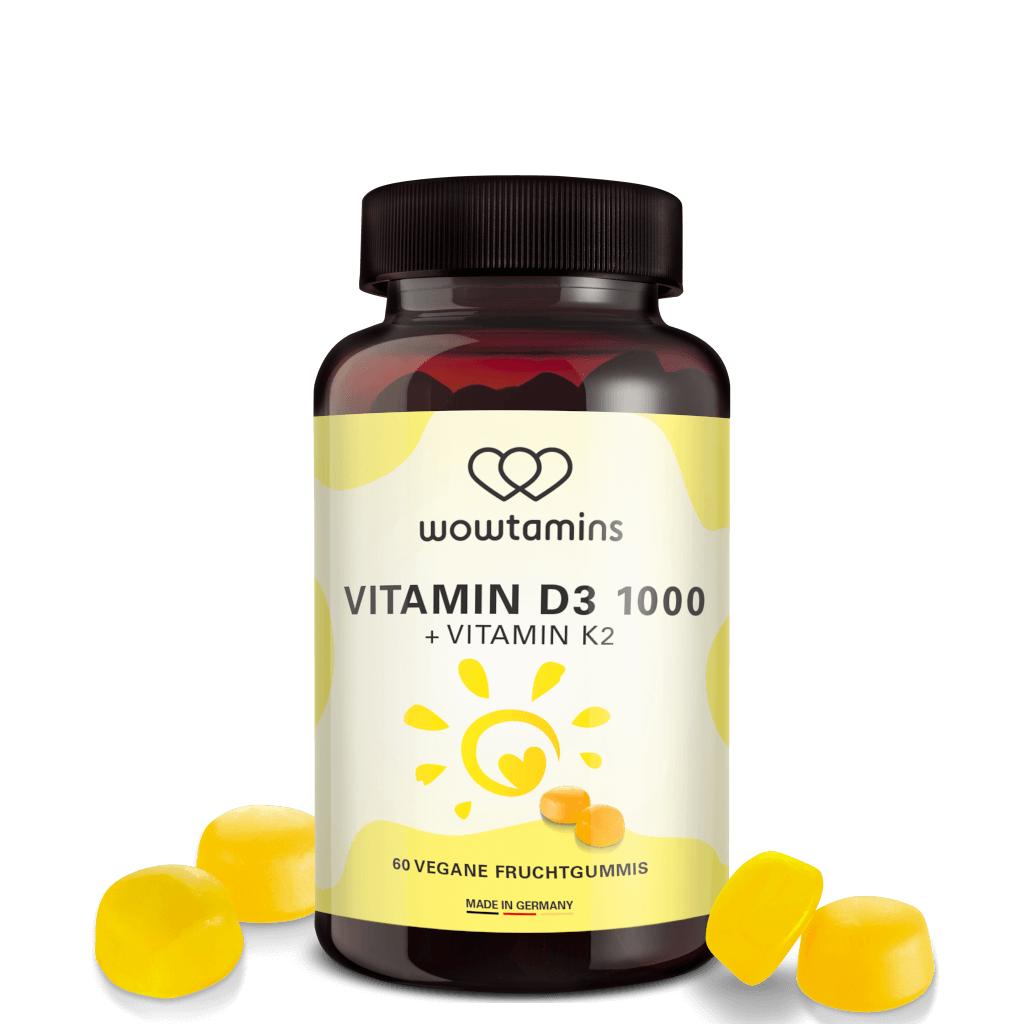
Vitamin K2-MK7 (all-trans)
as a delicious gummy
What should the dosage of dietary supplements be to prevent vitamin D deficiency in children?
It is best to follow the manufacturer’s recommendation. Even accidentally taking slightly higher doses poses no danger to children. In a clinical study involving 340 healthy schoolchildren, an international research team demonstrated that taking 2,000 IU of vitamin D3 for one year causes no undesirable side effects.28
Conclusion – Preventing vitamin D deficiency in children
Vitamin D performs a variety of vital functions in our body. Since most children and adults nowadays spend the majority of their time indoors, the body no longer produces sufficient amounts of this valuable nutrient on its own.
As a result, Western industrialized countries experienced an epidemic-like increase in vitamin D deficiencies. To prevent inadequate intake, children should expose themselves briefly to the sun around midday as often as possible in spring and summer. It is important not to apply sunscreen to exposed areas of skin.
From October to March, fatty fish and other foods containing vitamin D should regularly be included in the diet. In addition, taking a dietary supplement can help keep vitamin D levels within the normal range.
Sources
[2] Nair R, Maseeh A. Vitamin D: The "sunshine" vitamin. J Pharmacol Pharmacother. 2012 Apr;3(2):118-26.
[3] Rajakumar K et al. SOLAR ultraviolet radiation and vitamin D: a historical perspective. Am J Public Health. 2007 Oct;97(10):1746-54.
[4] Morris HA, Anderson PH. Autocrine and paracrine actions of vitamin D. Clin Biochem Rev. 2010 Nov;31(4):129-38.
[5] Carlberg C, Campbell MJ. Vitamin D receptor signaling mechanisms: Integrated actions of a well-defined transcription factor. Steroids. 2013 Feb;78(2):127-36.
[6] https://www.dge.de/wissenschaft/referenzwerte/vitamin-d/
[7] Kipshoven C. Cross-sectional study to assess vitamin D status in the population of Germany (DEVID study). Dissertation, University of Cologne, 2010; page 34.
[8] Heaney RP, Armas LA. Quantifying the vitamin D economy. Nutr Rev. 2015 Jan;73(1):51-67.
[9] https://www.kiggs-studie.de/deutsch/home.html
[10] Wabitsch M, Koletzko BV, Moss A. Vitamin D supply in infancy, childhood, and adolescence. Monatsschrift Kinderheilkunde 2011;159(8):766-74.
[11] Cashman KD. Vitamin D in childhood and adolescence. Postgrad Med J. 2007 Apr; 83(978): 230–235.
[12] Pawley N, Bishop NJ. Prenatal and infant predictors of bone health: the influence of vitamin D. Am J Clin Nutr. 2004;80(6):1748S–1751S.
[13] Ganmaa D et al. Vitamin D supplementation and growth in urban Mongol school children: Results from two randomized clinical trials. PLoS One. 2017 May 8;12(5):e0175237.
[14] Hyppönen E et al. Intake of vitamin D and risk of type 1 diabetes: a birth-cohort study. Lancet. 2001 Nov 3;358(9292):1500-3.
[15] Munger KL et al. Serum 25-hydroxyvitamin D levels and risk of multiple sclerosis. JAMA. 2006 Dec 20;296(23):2832-8.
[16] Nielsen NM et al. Neonatal vitamin D status and risk of multiple sclerosis: A population-based case-control study. Neurology. 2017 Jan 3;88(1):44-51.
[17] Salzer J et al. Vitamin D as a protective factor in multiple sclerosis. Neurology. 2012 Nov 20;79(21):2140-5.
[18] Gartner LM, Greer FR. Prevention of rickets and vitamin D deficiency: new guidelines for vitamin D intake. Pediatrics 2003;111(4 Pt 1):908–910.
[19] Hintzpeter B et al. Higher prevalence of vitamin D deficiency is associated with immigrant background among children and adolescents in Germany. The Journal of Nutrition 2008;138(8):1482-90.
[20] https://magazin.velux.de/artikel/indoor-generation-folgen.html
[21] Webb AR et al. Influence of season and latitude on the cutaneous synthesis of vitamin D3: exposure to winter sunlight in Boston and Edmonton will not promote vitamin D3 synthesis in human skin. J Clin Endocrinol Metab. 1988 Aug;67(2):373-8.
[22] Martinaityte I et al. Vitamin D Stored in Fat Tissue During a 5-Year Intervention Affects Serum 25-Hydroxyvitamin D Levels the Following Year. J Clin Endocrinol Metab. 2017 Oct 1;102(10):3731-3738.
[23] https://www.pharmazeutische-zeitung.de/ausgabe-062012/das-hormon-der-streithaehne/
[24] Trang HM et al. Evidence that vitamin D3 increases serum 25-hydroxyvitamin D more efficiently than does vitamin D2. Am J Clin Nutr. 1998 Oct;68(4):854-8.
[25] http://www.vitalstoff-lexikon.de/Vitamine-A-C-D-E-K/Vitamin-D/Lebensmittel.html
[26] https://www.geo.de/wissen/ernaehrung/vitamin-lexikon/20513-rtkl-rinderleber-diese-vitamine-stecken-drin
[27] https://www.google.com/url?sa=t&rct=j&q=&esrc=s&source=web&cd=1&cad=rja&uact=8&ved=2ahUKEwjytYfqvNjlAhXqHLkGHZbbBTsQFjAAegQIAxAC&url=https%3A%2F%2Fwww.dge.de%2Fuploads%2Fmedia%2FDGE-Pressemeldung-aktuell-01-2012-Vitamin-D.pdf&usg=AOvVaw33bdBNUUNQT4oMB4-DJXJw
[28] Maalouf J et al. Short- and Long-Term Safety of Weekly High-Dose Vitamin D3 Supplementation in School Children. J Clin Endocrinol Metab. 2008 Jul;93(7):2693-2701.
Food supplements are not a substitute for a balanced and varied diet and a healthy lifestyle.
Leave a comment
This site is protected by hCaptcha and the hCaptcha Privacy Policy and Terms of Service apply.