


Supporting healthy growth in kids: what really helps
A child’s growth is far more than just an entry in a health record. It is a living barometer of their overall health and development. Especially from the age of three, when little adventurers explore the world with increasing activity, growth is reflected in steady physical changes: They grow taller and stronger, master new movements, and rapidly develop their language and cognitive skills. Experts even describe growth as a “biological early warning system”¹, because physical or emotional strain can often first be reflected in slowed or unusual development.
For you as a parent, this means that closely monitoring your child’s growth can provide valuable insights into their health and quality of life. This article explains how growth is monitored in Germany, which foundations support healthy growth—and when targeted support through dietary supplements may play a useful role.
- How growth is monitored in Germany: Your guideposts
- Nutrition, exercise, and sleep: The unwavering foundation for healthy growth
- When growth gets out of sync: Understanding growth disorders
- Dietary supplements for children – useful or unnecessary?
- Tips for parents & professionals: How you can support healthy growth holistically
- Conclusion: Grow holistically—healthy, strong, and supported
- Frequently asked questions about growth in children and adolescents
How growth is monitored in Germany: Your guideposts
The U and J Examinations – A Personal Development Diary
In Germany, U and J preventive examinations help monitor children’s development². These appointments are particularly important from the age of three²:
-
U7a (34th to 36th month)
-
U8 (46th to 48th month)
-
U9 (fifth year of life)
-
J1 (between 12 and 14 years)
A pediatrician examines height, weight, motor skills, language development, and overall behavior. All results are documented in the yellow child health record. This not only allows conclusions to be drawn about individual growth but also reveals trends over the years.

Percentile charts – What is “normal” and how do you read them?
Doctors use percentile charts to assess growth. These show how measurements such as height or weight develop compared with children of the same age. The KiGGS reference data from the Robert Koch Institute (RKI) represent the average of German children³, while the WHO growth standards describe ideal growth under optimal conditions⁴. Both complement each other and help provide a sound assessment of a child’s growth. If a child is at the 50th percentile, this means that 50% of children are shorter and 50% are taller. Important: The curve’s progression is more significant than a single measurement.
Nutrition, exercise, and sleep: The unwavering foundation for healthy growth
To reach their full growth potential, children need a stable foundation of the right building blocks.
Age-appropriate nutrient intake from preschool age: What belongs on the plate
A balanced diet is essential for healthy growth. From the age of three, children need specific nutrients and energy to play actively and learn. Vitamins and minerals (e.g., calcium for the bones), as well as proteins (e.g., for muscle growth and many other bodily processes), should always be part of a growing child’s diet. Ideally, the plate should contain plenty of fruit, vegetables, and whole-grain products, supplemented with dairy products, fish, and little meat⁵. Make sure your child drinks plenty of water.
Reality shows that it is often challenging to implement these recommendations in everyday life. Particularly picky eaters or the high proportion of sugar and unhealthy fats in many “children’s foods” can make it difficult to ensure adequate nutrient intake⁶.
Would you like to learn more about which vitamins and minerals are particularly important for children? Then read our detailed articles:
Exercise & sleep – the often underestimated partners in growth
In addition to nutrition, Exercise and sleep plays a crucial role in growth and overall development:
-
Exercise: At least 60 minutes of exercise a day¹.
-
Sleep: Depending on their age, children need 10 to 12 hours of nighttime sleep¹.

When growth gets out of sync: Understanding growth disorders
When is it a growth disorder?
Not every child who is shorter than their peers immediately has a problem. Every child has their own growth rate and genetic predisposition. However, a sudden drop on the growth chart or growth below the 3rd percentile over an extended period can be a serious sign of a growth disorder⁷.
The S1 guideline “Short stature” from the German Society for Pediatric and Adolescent Endocrinology and Diabetology (DGKED) lists various causes⁷:
-
Hormonal causes: A deficiency of growth hormones is one of the most common treatable causes.
-
Genetic causes: For example, Turner syndrome or other congenital syndromes.
-
Chronic diseases: Conditions such as celiac disease (gluten intolerance), chronic kidney disease, or heart defects can impair growth.
-
Malnutrition: If insufficient nutrients are supplied over a prolonged period, this can directly hinder growth.
-
Psychosocial reasons: In rare cases, extreme stress or neglect can affect growth.
In such cases, a comprehensive assessment by specialised paediatricians (often paediatric endocrinologists) is absolutely necessary. National medical guidelines help establish the correct diagnosis and initiate appropriate treatment if necessary.
Dietary supplements for children – useful or unnecessary?
Although a varied diet is generally sufficient, there are certain situations in which multivitamin supplements, for example – after consultation with a doctor – can be a useful addition. This applies, for instance, to children who are particularly picky eaters and may therefore not consume all the important nutrients.
Children with chronic conditions that impair nutrient absorption in the gut – such as coeliac disease or Crohn’s disease – may also benefit from targeted support to compensate for potential nutritional gaps.
With a purely plant-based diet, particularly careful guidance is important. In many cases, supplementation with certain vitamins such as vitamin B12 and other critical nutrients is needed to optimally support children’s development. Find out more in our article Nutrition and nutrients for vegan & vegetarian children.
What should you consider when dietary supplements come into the picture?
If your paediatrician recommends supplementation, pay attention to these points:
-
Quality and purity: Choose products from trusted manufacturers that meet high quality standards and are free from unnecessary additives.
-
Age-appropriate dosage: Nutrients must be precisely tailored to children’s needs to avoid overdosing.
-
Ingredient transparency: Look for clear information on all vitamins and minerals contained.
-
Children’s acceptance: A child-friendly dosage form (e.g. as tasty gummies) can make regular intake easier – but it should not become a substitute for sweets⁶.
Here, we are proud to introduce our Vitamin Gummies, specially developed to supplement important nutrients for children in a tasty, child-friendly way – naturally, in appropriate dosages and with the highest quality standards. Find out more on our product page!
Our all-round gummy supplement for children
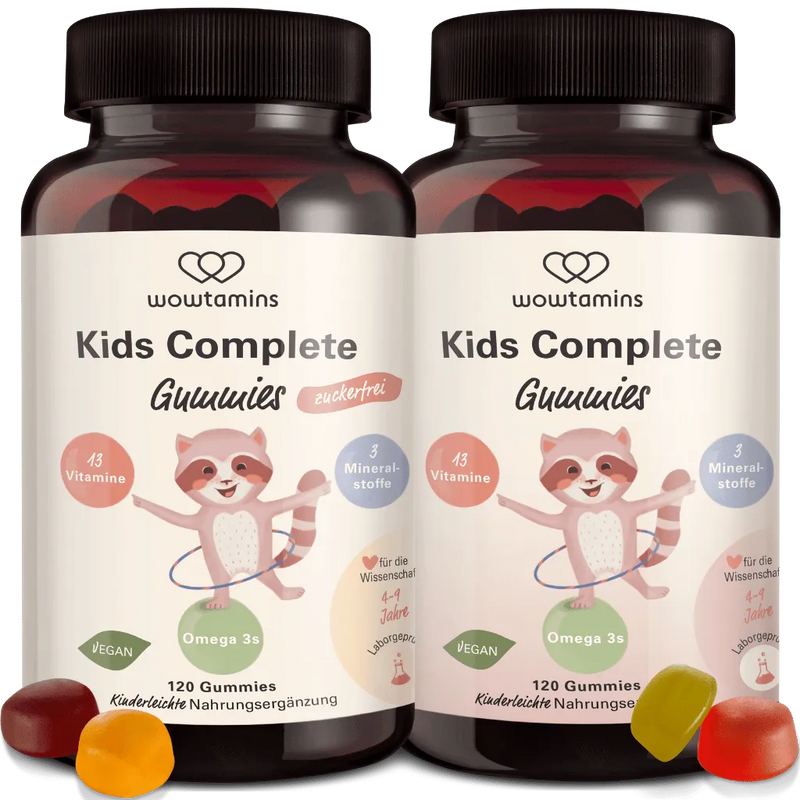
Kids Complete
Vitamins, minerals & omega-3s
» Do you already know our Multivitamins for Children guide? In this comprehensive guide, our team at wowtamins, consisting of parents and experienced experts, provides you with an honest and well-founded overview of the need for dietary supplements for children.
Tips for parents & professionals: How you can support healthy growth holistically
-
Pay attention to regular, balanced meals:Offer plenty of fresh fruit, vegetables, and whole-grain products, and reduce sugar and highly processed foods.
-
Exercise is fun!Encourage daily activity—play, run, and climb together, preferably outdoors in the fresh air.
-
Create a loving sleep environment:Ensure sufficient nighttime rest and consistent sleep schedules so your child's body can regenerate optimally.
-
Attend the U and J checkups:Use these important appointments to monitor growth and development, and diligently keep the yellow booklet up to date².
-
Talk to a pediatrician or naturopath:Before using dietary supplements, consulting a pediatrician or naturopath is essential.
-
Advocate for good catering in daycare and school:A healthy food environment in educational institutions benefits all children.
Conclusion: Grow holistically—healthy, strong, and supported
Healthy growth is a complex and beautiful interplay of a balanced diet, active exercise, restorative sleep, and loving care. It is not a finished product from a package, but a continuous process that you as a parent can actively and attentively support.
Dietary supplements can be valuable support in carefully considered individual cases when there is an increased need or a diagnosed deficiency. However, they are not a substitute for a healthy lifestyle. Attentiveness, love, and meaningful time together are the true foundation on which children can literally grow—in good health, strong, and full of joy for life.
Frequently asked questions about growth in children and adolescents
How can I specifically support my child's growth during adolescence, and what factors influence adult height?
Growth during adolescence and later adult height are influenced by a complex mix of factors. While genetics plays the primary role, you as a parent can provide supportive options. A balanced diet with sufficient protein and all essential nutrients is crucial.
Regular physical activity and sufficient sleep also promote physical growth, as growth hormones are released primarily at night. Environmental factors, stress, and chronic illnesses can affect growth.
Professional advice from a pediatrician or naturopath is important for assessing individual growth rates and detecting any nutritional deficiencies or other abnormalities at an early stage.
What are the particular features of pubertal development and the growth spurt in girls and boys?
The growth spurt during puberty is a central process in human physical development. In girls, pubertal development typically begins earlier than in boys. The first signs are often breast development and pubic hair, followed by the first menstrual period, which indicates the onset of sexual maturity.
In boys, these changes occur later, usually beginning with testicular growth and pubic hair. Both sexes experience a significant growth spurt during this phase, with the rate varying from person to person. After puberty ends, growth slows until adult height is reached.
What is growth hormone deficiency, and what might treatment look like for children and adolescents?
Growth hormone deficiency means that the body does not produce enough growth hormone, resulting in a reduced growth rate. This is one possible cause of short stature that requires specialized treatment.
Diagnosis is made by a professional pediatric endocrinologist, often after slowed growth is observed compared with the percentile chart. Treatment generally consists of daily administration of synthetic growth hormone.
The goal of this therapy is to normalize the height growth curve and improve the affected child’s or teenager’s final adult height until the growth plates have closed. Early consultation and diagnosis during childhood are crucial.
Why is a healthy diet so important for the physical growth of children and adolescents through their teenage years?
Proteins are fundamental building blocks for overall body growth and development, as they are essential for building muscles, bones, tissue, and hormones. Especially during childhood, adolescence, and the teenage years, when the growth rate is high, the need for high-quality proteins increases.
A nutrient deficiency, particularly a protein deficiency, can impair growth in height and overall development. A balanced intake of foods such as lean meat, fish, eggs, dairy products, legumes, and nuts optimally supports children in reaching their full growth potential and becoming healthy and strong adults. The rule is: Protein quality and quantity matter.
References
[1] Federal Centre for Health Education (BZgA). (n.d.). Growing Well – How to Support Your Child’s Development from Birth to Age 6. Available at: https://shop.bzga.de/media/amasty/amfile/attach/Z9vmJW5kFWIscdaSYRJSnzDgKZpBt1ag.pdf
[2] Gesundheitsinformation.de(Institute for Quality and Efficiency in Health Care - IQWiG). (2022). U examinations. Available at: https://www.gesundheitsinformation.de/u-untersuchungen.html
[3] Robert Koch Institute (RKI). (2018). Reference Percentiles for Anthropometric Measurements and Blood Pressure from the Study on the Health of Children and Adolescents in Germany (KiGGS). Available at: https://www.rki.de/DE/Content/Gesundheitsmonitoring/Studien/Kiggs/Referenzperzentile/referenzperzentile_node.html
[4] World Health Organization (WHO). (n.d.). WHO Child Growth Standards. Available at: https://www.who.int/tools/child-growth-standards
[5]Paediatrie.at(Austrian Society for Pediatric and Adolescent Medicine). (n.d.). Dietary Recommendations. Based on DACH reference values (DGE, ÖGE, SGE). Available at: https://paediatrie.at/images/Referatsleiter/Referat_Ernährungskommission/LeitlinienBMG/ernahrungsempfehlungen_4-10_jahrige_final.pdf
[6] Consumer Advice Centre. (2022). Vitamins and Minerals for Children: Usually Unnecessary and Expensive. Available at: https://www.verbraucherzentrale.de/aktuelle-meldungen/lebensmittel/nahrungsergaenzungsmittel-fuer-kinder-sind-meist-zu-hoch-dosiert-25949
[7] AWMF online (Association of the Scientific Medical Societies). (2023). S1 Guideline on Short Stature. Available at: https://register.awmf.org/assets/guidelines/174-004l_S1_Kleinwuchs_2023-07.pdf
[8] Federal Institute for Risk Assessment (BfR) German Nutrition Society (DGE). (2023). Selected Questions and Answers on Vitamin D - Joint FAQ of the BfR and the German Nutrition Society (DGE). Available at: https://www.bfr.bund.de/cm/343/ausgewaehlte-fragen-und-antworten-zu-vitamin-d.pdf
[9] Lassi, Z. S., Bhutta, Z. A. (2021). Zinc supplementation for preventing mortality, morbidity, and growth failure in children aged 6 months to 12 years. Cochrane Database of Systematic Reviews, 10(10). Available at: https://www.cochranelibrary.com/cdsr/doi/10.1002/14651858.CD009384.pub3/
[10] Isanaka, L. A., et al. (2021). Effect of Oral Nutritional Supplementation on Growth in Children with Undernutrition: A Systematic Review and Meta-Analysis. Nutrients, 13(9), 3122. Available at: https://www.ncbi.nlm.nih.gov/pmc/articles/PMC8468927/
Leave a comment
This site is protected by hCaptcha and the hCaptcha Privacy Policy and Terms of Service apply.